Drawing by Mona
A path of experience and practice in Vienna
Fewer musts. More you.
At our practice evenings in Vienna, we move, become still and try things out together. I bring simple exercises from Qi Gong and Body Intelligence.
In doing so, we can discover how much there is in softness. Sometimes a movement becomes easier precisely when we force less. There is time for sensing afterwards, for questions and for laughter.
Time and again, I am amazed at how much strength we have when we are in touch with ourselves.
Notice. Trust. Move.
Notice what is really there.
Trust what wants to reveal itself.
Move what wants to come alive.
In touch with yourself – and in contact
Sometimes we are quick to focus on the other person, on the problem or already on the solution – and in doing so, we move a little away from ourselves.
At KI-mo, we explore how we can reconnect more with ourselves – while staying in contact and in motion.
A moment before you read on
For a moment, feel your feet on the floor.
Notice how you are sitting or standing right now.
You do not have to change anything.
What do you notice when you do not immediately tell your body how it should be?
This is not yet “the method”. But it is a beginning: noticing before we intervene.
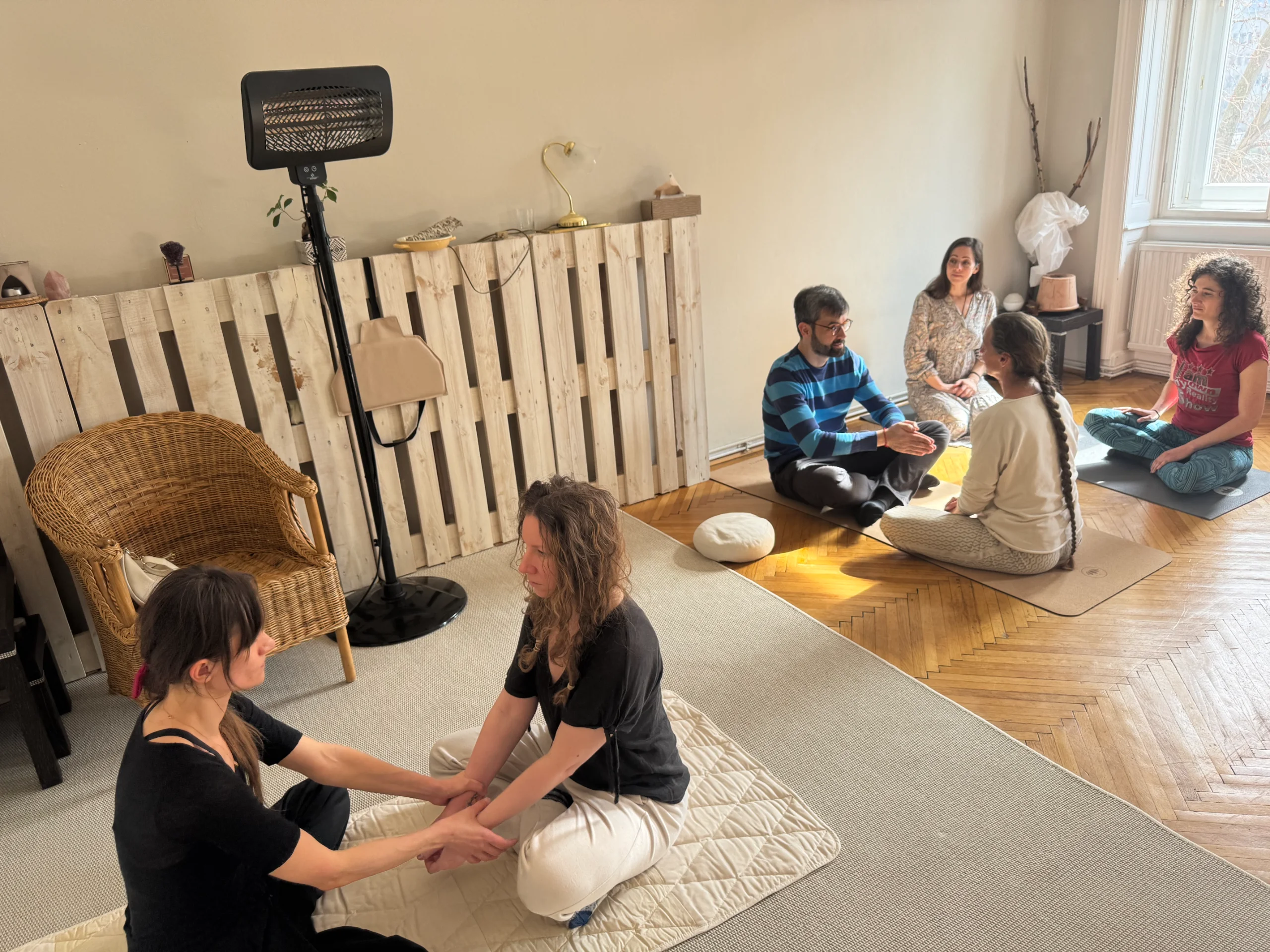
From one of our workshops in Vienna
What we actually do
We stand, move, become still, try things out and observe. You do some exercises alone, others in pairs or together as a group. Some moments become very still – and sometimes we cannot help laughing together because a familiar reaction suddenly becomes so clearly visible.
Settling into the body
With simple elements from Qi Gong and the internal arts, we open the body and notice how we really are right now.
Changing one small thing
For example, we change our attention, tension or inner attitude and observe what happens. Does our stance become softer when we hold on less? Can a movement be light and have strength at the same time?
Sometimes a small, voluntary challenge helps us sense differences more clearly: light resistance, an unfamiliar distance or a little impatience in the interaction. This lets us notice how we react automatically – and what changes when we struggle less and reconnect more with ourselves.
Exploring encounter
In pairs, we discover differences that can easily go unnoticed on our own: How does a movement change when someone accompanies it? When does contact feel easy and connected? Closeness, distance, touch and boundaries are also part of this – and become directly perceptible as we practise.
Sensing afterwards and integrating
We do not chase an effect. We pause, describe honestly what happened and consider what might be helpful in everyday life.
Sometimes something surprising happens. Sometimes almost nothing. Both are welcome.
How people have experienced KI-mo
“It was a wonderful and very mindful time for me. Paul guided me through these sessions with a lot of love – and we laughed a great deal, too. I discovered ‘strengths’ in myself that I did not know I had, and experienced many moments of noticing, of sensing myself and of accepting myself.”
 Gabriele KI-mo participant Translated from German.
What makes KI-mo special
The movements come from Qi Gong and the internal arts. Unlike a traditional Qi Gong class, though, the focus is less on performing a form correctly and more on the attitude with which you practise.
The experience is the experiment
We do not have to prove anything. First we experience. Then we look closely: What actually happened? An explanation can emerge later – and can also remain open.
Forcing less, letting more happen
Sometimes a movement or response that feels right arises more easily when we notice more closely, force less and do not decide in advance what it must look like. In Daoism, this attitude is called Wu wei: acting without unnecessary forcing.
The whole person takes part in the practice
Body, thoughts, feelings, energy, intuition and relationship are not considered separately from one another.
A boundary is part of the practice
A no, a not yet, more distance or a pause are not disruptions. They are part of conscious awareness.
Experience KI-mo together
You do not need any skills
You need no experience with Qi Gong, meditation or bodywork. You set your own pace, and touch is voluntary.
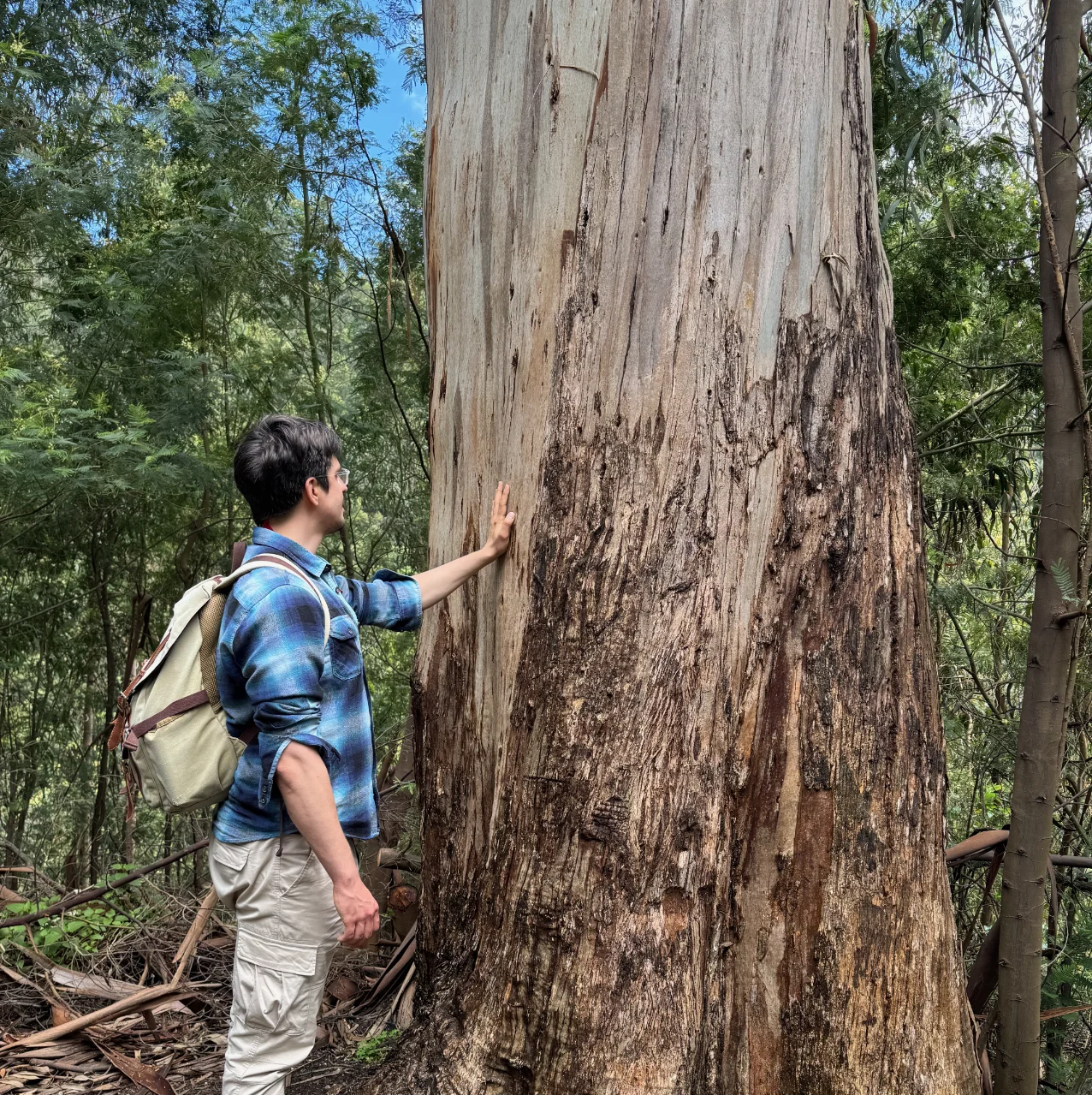
To explore further
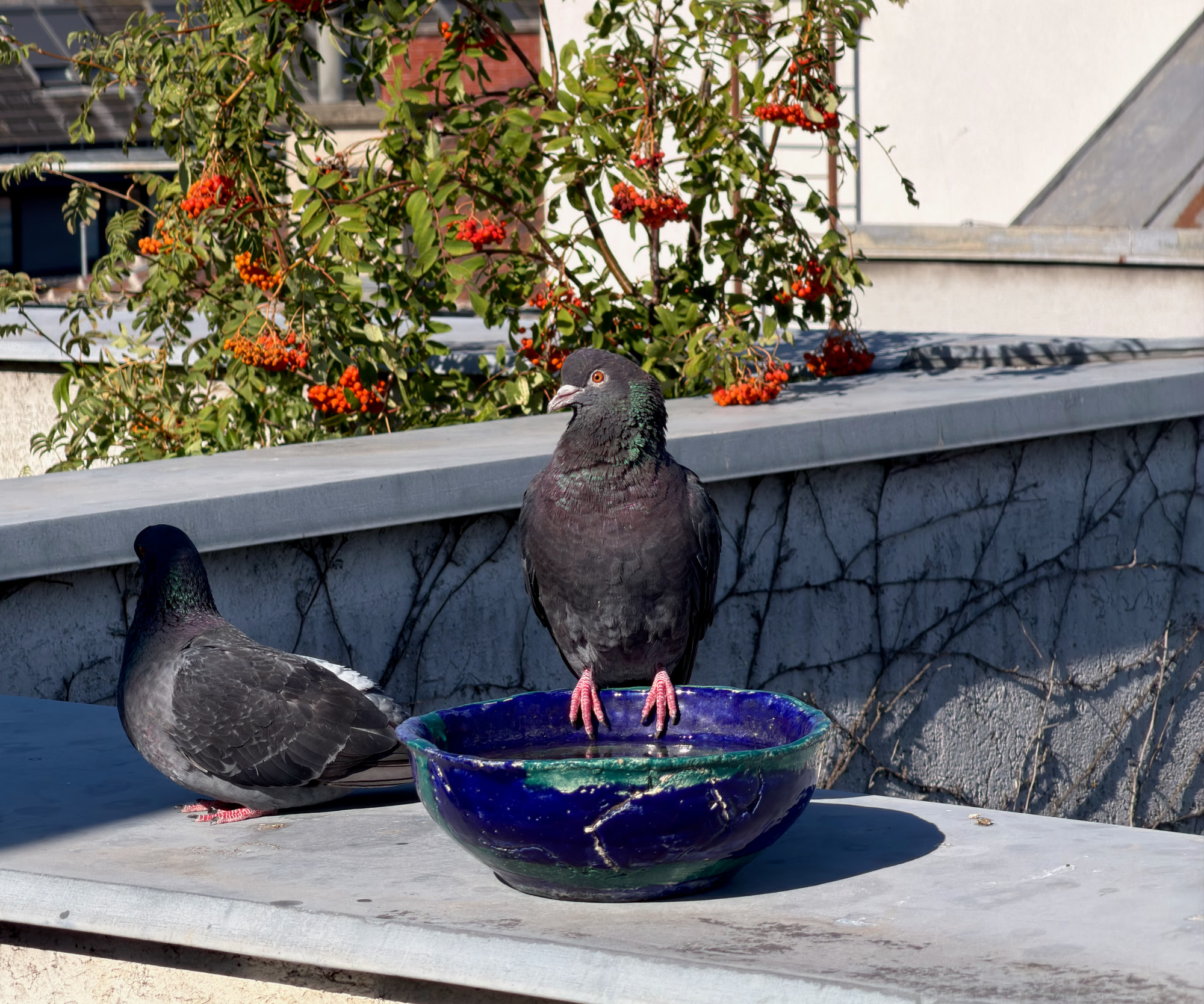
The still moment before action
The intention remains. Only the urgency grows quieter.
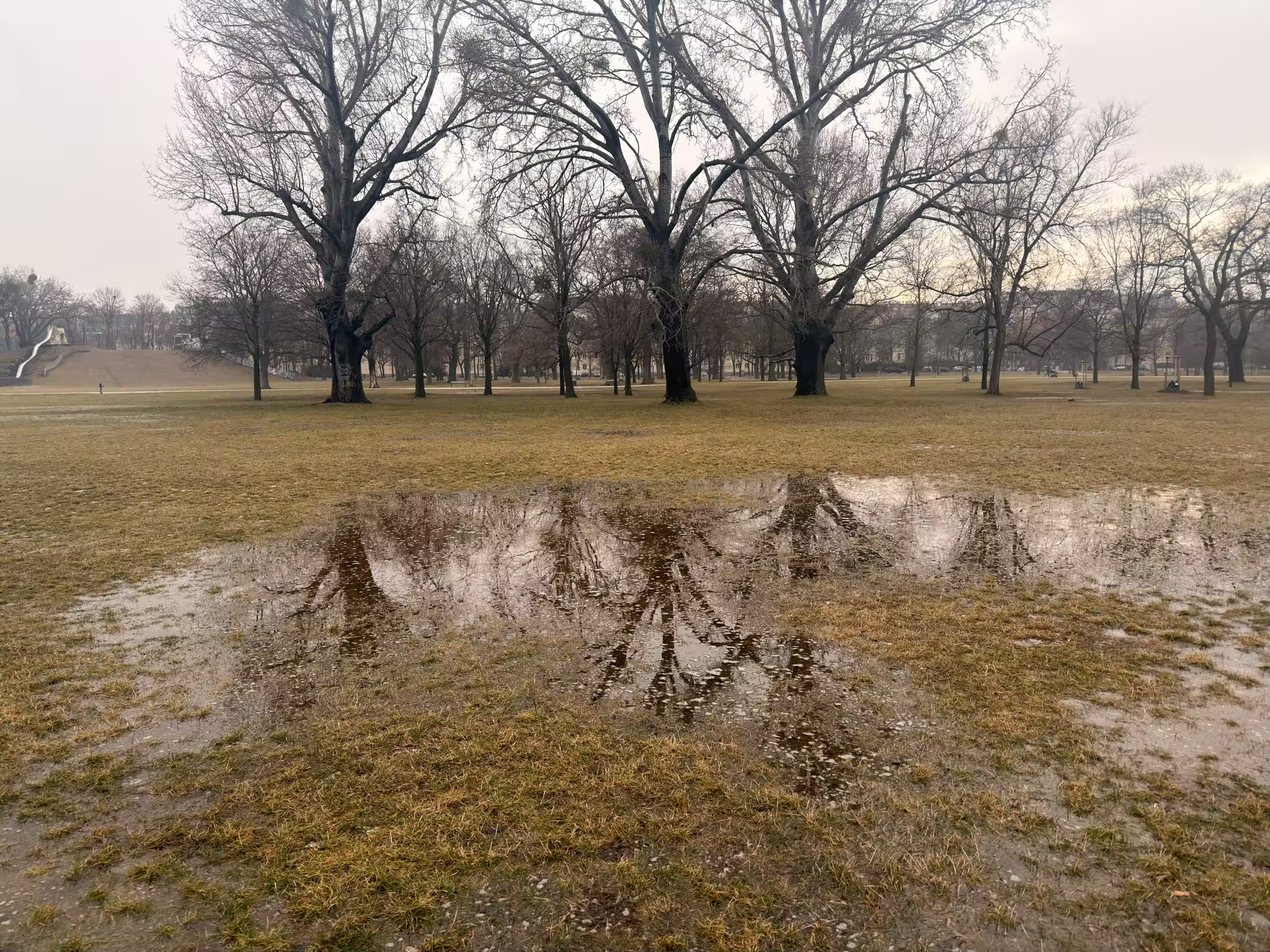
Observing the space between things
What happens when you look not at things – but at the space between them?
What is Qi Gong?
An ancient practice from China that combines stillness with movement. On Dao, Yin and Yang – and the relationship between attention and energy.
There is only so much words can explain about KI-mo
The simplest way is to practise together and have your own experience.