About Paul
It is good to have you here.
I am Paul, and I created KI-mo out of my own practice.
I am fascinated by what happens when we become truly attentive: to the body, our thoughts and feelings, our energy – and to what arises between people.
How do I really feel – and what is needed right now?
How I got here
I did not start with a plan to invent a new method. It began with curiosity:
Why does a small shift in attention sometimes change the whole body? Why do we often feel something before we can explain it? And why does more effort not always help?
Through Qi Gong, Nei Gong, meditation, Body Intelligence and Advaita, this gradually grew into a path of experience of my own.
Alongside KI-mo, I work as a team leader in software development. This contrast matters to me: practice should not only work in a quiet room. I am interested in what remains of it on a Monday morning, in a difficult conversation, a decision or a clear boundary.
What inspires me about KI-mo
Many of us have learnt to function well. We think ahead, adapt and try to do the right thing.
In doing so, we sometimes notice less of what is happening in the body, what feeling is present or what next step would really feel right.
I keep coming back to the same question: Am I really in touch with myself right now – or is my attention already on the other person, the problem or the next solution? For me, KI-mo is also a way to notice this difference ever more subtly in the body and in encounter.
KI-mo grew out of a wish to bring these aspects together again: movement and stillness, body and mind, emotions and energy, intuition and clear thinking, personal experience and encounter.
I enjoy the quiet moments just as much as those when a group suddenly laughs because a small exercise makes something unexpected visible.
How I guide
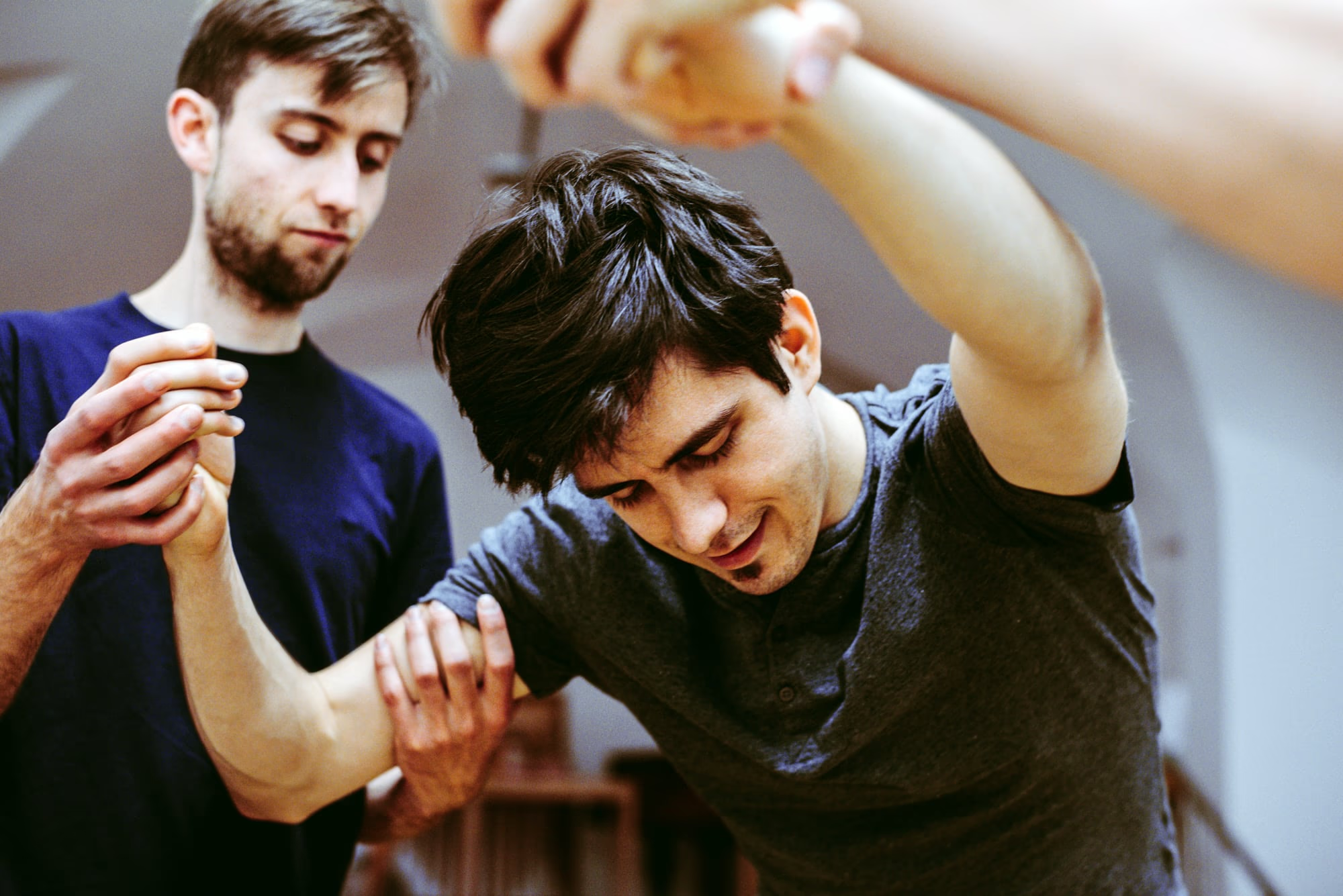
I guide the exercises clearly while leaving room for your own perception.
I do not give you a ready-made answer about what you should feel or experience. Together, we observe what actually happens and what ways of responding to it might be helpful and responsible.
Voluntary participation, consent and personal boundaries matter to me. Nobody has to experience anything special, share anything personal or cross a boundary.
What has shaped me
Self-responsibility and direct experience
Alberto Hernandez and Yoga of Self Responsibility showed me a practice that combines personal responsibility and direct experience.
Body Intelligence
Dominik Remde guided me in exploring more closely how bodily signals, stress reactions, movement and new possibilities for responding interact.
Daoist internal arts
With Adam Molnár and through my ongoing practice in the Lotus Nei Gong tradition, I learnt and continue to learn about structure, precision, Qi Gong and inner development.
Advaita Vedanta
James Swartz introduced me to the clarity of the Advaita tradition and the question of what remains unchanged amid changing experiences.
Not all of this translates directly into a KI-mo exercise. KI-mo is my own evolving synthesis – the teachers mentioned are influences, not a formal endorsement.
Practising as we live
For me, practice does not end after an exercise.
It shows itself in how we listen, speak, lead, decide and act. Thoughts, words and actions do not have to align perfectly. We can, however, notice more honestly where they diverge – and find greater alignment step by step.
What KI-mo is – and what it is not
I offer a guided space for experience and practice. KI-mo is not psychotherapy, medical treatment or a promise of healing.
Professional support may be necessary for physical or mental health concerns. The workshop is not about making diagnoses or interpreting experiences for others.
Curious?
There is only so much words can explain about KI-mo. The simplest way is to practise together and have your own experience.