KI-mo practice evenings in Vienna
Come as you are. You need no prior experience and do not have to feel or be able to do anything in particular.
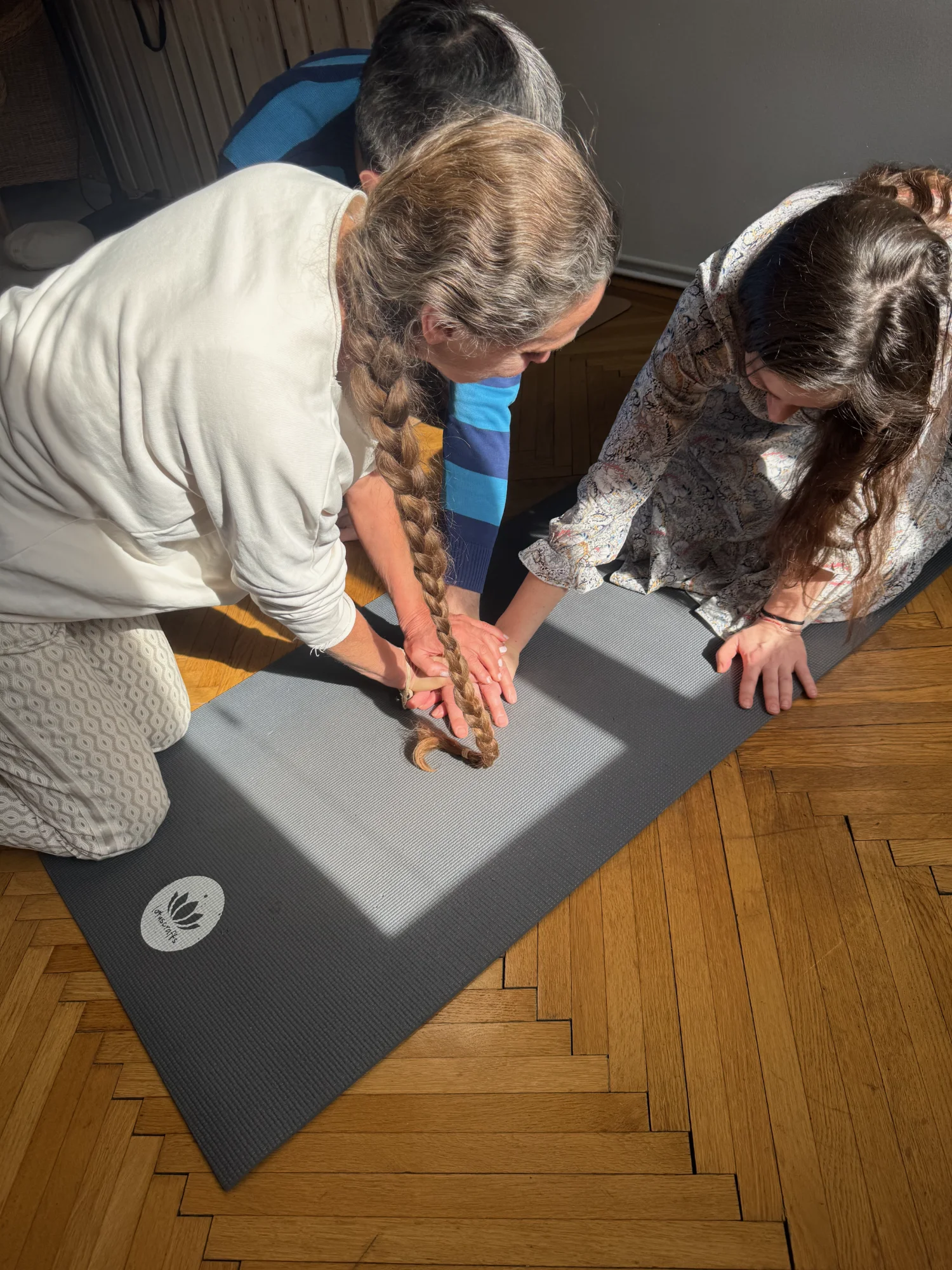
Practising together. Noticing with curiosity.
The next KI-mo evening is being planned
Just send me a short message saying “next event” – then I will get in touch as soon as the new date is set.
How a typical practice evening unfolds
In many exercises, we explore how you can stay in touch with yourself or reconnect with yourself through movement and encounter – while the situation and the other person are still there.
Arriving
We orient ourselves in the room and settle into our bodies: depending on what the moment needs, with Qi Gong, stretches, tapping the body or sometimes even strength exercises.
Opening up and noticing
Standing, stillness or movement that is allowed to arise by itself create a shared starting point. Sometimes we meditate in stillness, with brief guidance or without any technique at all.
Experimenting
We change individual factors or work with a previously agreed challenge. Then we observe what shows up in strength, movement, feeling or attention.
Meeting
In voluntary partner exercises, we explore contact, leading, trust and boundaries – sometimes with resistance or an emotional quality, both agreed beforehand.
Sensing afterwards
Time to let things settle and to share. Speaking often clarifies what was previously only a feeling – you do not have to share anything.
Frequently asked questions
Getting started
Do I need prior experience?
No. The exercises are guided and can be adapted. Curiosity is enough.
Do I need to be flexible or sporty?
No. It is not about perfect forms or performance. There is no level you have to reach.
Can I come on my own?
Yes. You do not have to bring anyone or know anyone. In partner exercises, you decide whether to practise and with whom.
Do I have to believe in Qi?
No. You can simply observe what you actually notice. The experience is real; the explanation can remain open.
I have questions about accessibility or physical limitations.
Write to me beforehand. Then I will discuss honestly with you what the specific space allows and which adjustments make sense.
The evening
How many people take part?
Usually between 2 and 8. In a group this small, there is room for questions, for your own pace and for adjustments.
What should I bring?
Comfortable clothing – and, depending on the event, a meditation cushion, a mat or something to drink. The exact list is in the details for each event.
Where exactly does it take place?
You will find this in the details for each event. For the indoor space in 1020 Vienna, the nearest station is U3 Kardinal-Nagl-Platz; the exact address is not listed publicly on the website, and you receive it with your registration confirmation.
How much does an evening cost?
Pay what you can: you choose the amount yourself, between 5 and 25 € – or whatever feels right for you. You will find the exact arrangements in the details for each event.
Do we also work with pressure, resistance or emotions?
Some exercises include a previously agreed challenge, for example physical resistance or impatience in the interaction. It does not always have to be gentle, but it always stays within your boundaries and without pain. We agree beforehand how strong it is and how long it lasts.
There are no personal attacks, unexpected confrontations or compulsory touch. You can change the intensity, pause or end the exercise at any time.
What if something intense comes up during an exercise?
Then we stop. First, we orient ourselves in the room again – looking around, the floor, breathing, distance – and you choose what helps you right now: sitting, standing, water, stillness or stepping outside for a moment.
At that point, it is not about deepening the feeling or looking for a cause, but about helping you feel present and at ease again. If something needs more than this setting can offer, I will tell you honestly. KI-mo is not a substitute for medical or psychotherapeutic treatment.
Your own boundaries
Do I have to join in with everything?
No. Watching is an equally valid way to participate. You can choose a smaller variation, take some distance, pause or stop at any time – a no needs no explanation.
Do I have to touch other people?
No. Partner work is important, but each instance of touch is voluntary and requires consent.
We clarify beforehand what is OK. If the type of touch, the area of the body or the intensity changes, we ask again. A stated boundary is enough – it does not have to be physically obvious or explained.
Do I have to talk about personal things?
No. You decide whether and what you would like to share.
Speaking is not just a report afterwards. When we put something into words, what was previously only felt often becomes apparent in a different way – expression is itself part of the exercise. There is space for anyone who wants to use it. Anyone who prefers to remain quiet is just as welcome.
What happens to what I share?
We agree to treat the personal experiences of others confidentially. I do not share personal stories outside the group with names or identifiable details, and I do not use them for advertising either. Your experience belongs to you – nobody interprets it for you.
What if I would like to explore further?
Then say so – beforehand or during the evening. There are smaller and larger variations, and some exercises go further if you would like them to.
You decide how far you engage – you do not have to show any of it. This can be loud or very quiet, spoken, written or just for yourself. How intense something feels says nothing about how well you are practising. You can choose a smaller variation, pause or stop at any time.