The still moment before action
An impulse arises: I want to say something. Reply to a message. Get up and do something. And before I have consciously decided, my body is already on its way. I lean forwards, my breath becomes a little shallower, my shoulders tense.
Often I do not even notice that a small effort has arisen alongside the intention. As if I first had to create tension in myself before I could begin.
But perhaps not every action needs this inner run-up.
The intention can remain
What happens when we do not immediately follow an impulse? Not to suppress it or overthink it. Just for one breath.
In this brief pause, we can notice the state from which we are about to act. Is the jaw tight? Has the gaze narrowed? Is something inside us pushing to reach a result as quickly as possible?
We do not then have to give up the intention. We can simply let it be there while releasing a little of the tension: breathe out, feel the floor, let the shoulders drop, let the gaze widen again.
The intention remains. Only the urgency grows quieter.
Then we act – or notice that we do not want to follow the first impulse after all.
Not doing nothing – forcing less
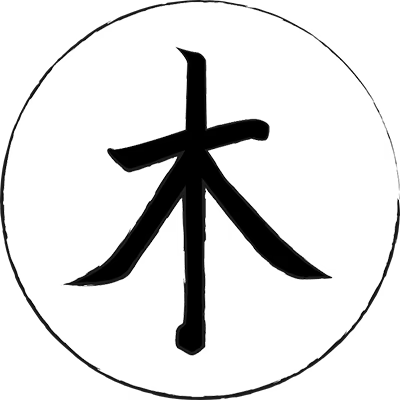
In this, I recognise something of the Daoist principle of Wu wei. It is often translated as “non-action” and easily misunderstood as passivity. It does not mean that we remain inactive. For me, it means acting without unnecessary forcing.
An action can be clear and powerful without becoming tense. It is like lifting an object: if we tense up everywhere beforehand, the movement becomes heavy. If we first notice the weight and use only the strength that is actually needed, a different quality can emerge.
This makes a difference in conversation too. A sentence that comes from the pressing need to be heard or understood sounds different from the same sentence after a calm breath.
For me, Wu wei here does not mean having no intention. It means not loading the intention with more force than it needs.
One breath of freedom to choose
We can try this in small, unremarkable situations:
- Notice an impulse or an intention.
- Do not begin immediately; stay here for one breath.
- Feel the contact with the floor or the chair.
- Let tension ease where it is not needed for the action.
- See what movement arises from this state.
Perhaps the action stays exactly the same. Perhaps it becomes calmer, smaller or clearer. Perhaps it changes direction. And sometimes we realise that we do not want to follow the first impulse at all.
Pausing does not automatically tell us what is right. But it creates a little more room to distinguish between impulse and response.
No new demand
This is not about being completely relaxed before every step. That, too, could quickly become a new demand: I can only act when I am calm enough.
Sometimes there is no time to pause. Sometimes we remain tense and still do what is necessary. The exercise belongs in those many moments when one breath is possible.
Relaxation here is not a special state we have to reach. Perhaps, just for a moment, we leave out what makes the action harder.
Where an action begins
We often think an action begins with the visible movement. Perhaps it begins earlier: in the way we prepare for it inwardly.
There is a small space between intention and action. If we notice it, we do not have to push ourselves immediately. We can first sense, soften a little and then act.
Perhaps Wu wei shows itself in everyday life just as quietly: not doing less, but allowing action to begin without unnecessary resistance.