
Our inner observer
In this article, I would like to tell you something about our consciousness.
This is not a personal idea of mine, but a teaching thousands of years old from Advaita Vedanta in India – as I came to know it through my teacher James Swartz.
All living beings are conscious. But what does it mean to be conscious? What actually is consciousness?
The many names of consciousness
There are many names for consciousness. To name just a few:
- the Self (not to be confused with the “higher self”)
- existence
- the unchanging
- the Absolute
- awareness
- or simply: the inner observer.
Consciousness accompanies us in every single experience – and that is precisely why we so easily overlook it. It is a little like gravity: it constantly holds us to the ground, and because it is always there, we hardly notice it.
Become conscious now that you are conscious. Sense, feel, enjoy.
That is the whole exercise. It takes a moment and can be repeated anywhere.
Our sensory perceptions shape the mind
Let us slowly explore the difference between mind and consciousness.
Through the sense organs – eyes, ears, nose, tongue, skin – our body perceives the world in its colours, sounds, smells, tastes and sensations.
Advaita describes it like this: the mind takes the form of what the senses receive. When you look at a mountain in the distance, you see a mountain. But do you notice that your mind has taken the form of the mountain so that you can see it?
For those who can follow this, it also becomes understandable why the teaching says: there is no distance between you and the world.
Consciousness observes our mind
You can imagine consciousness as an infinite, limitless field.
This field shines like a light on the experience in your mind. The light is reflected, and you – as consciousness – can perceive it.
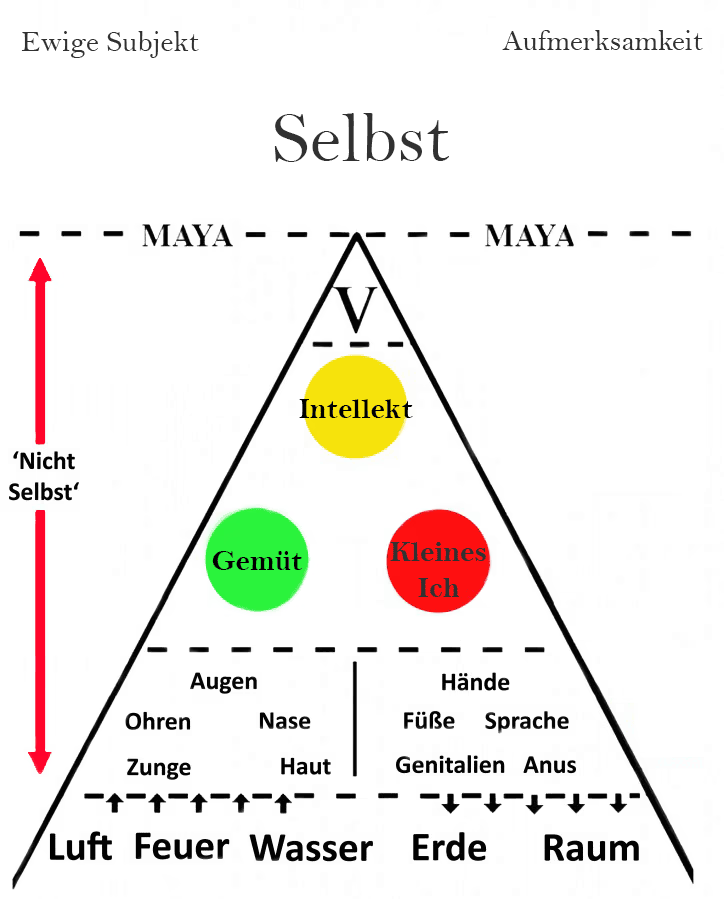 A diagram from Advaita Vedanta: the mind (intellect, emotional mind, small I) and, distinct from it, the Self.
Consciousness is unchanging
Advaita says: consciousness is not changed by any experience.
This means: your consciousness as a child, now and in old age is exactly the same. Body and mind change – the inner observer remains your fixed point.
For me, this thought is one of the most helpful in this teaching when it comes to inner peace. Only you can notice whether it holds true for you.
Our true identity includes the unchanging
We usually identify with our body, our emotions and our thoughts. The I possesses, has, wants to have or does not want to have. We say: “I have this or that problem. I am the way I am because of my past.”
Much suffering arises from thoughts of this kind.
As soon as we discover the unchanging consciousness within us, our identity expands. We can notice that what is essential within us does not change.
In the language of the tradition, this self-knowledge makes the mind stable and calm – and that is precisely what is regarded there as the real “goal” of spiritual practice.
Consciousness is limitless and free of judgement
Consciousness is free of judgement. It has no qualities. Nothing can be attributed to it, because it is the subject within us that can never be an object.
Every judgement takes place in the mind – and is therefore changeable.
Consciousness is whole and complete
Because consciousness is free of qualities that can be judged, Advaita concludes: it is always whole and complete.
If you sometimes feel incomplete, the teaching offers a way of reading that feeling: it belongs to the mind, not to consciousness. From this perspective, you are complete – whoever or whatever you are or whatever you do. You can explore for yourself whether this interpretation brings you relief.
Consciousness is non-dual
Consciousness is non-dual (advaita). This means: consciousness has no opposite. Advaita Vedanta says that everything is consciousness.
Wherever you look, whatever you feel – according to this teaching, consciousness can be found in it. It is everywhere and permeates everything.
This also means: everything you observe is consciousness too. It is the human mind that divides everything into parts – body, mind, other people, surroundings.
Whoever recognises consciousness within themselves can also see it in all other living beings. For me, over the years, this has led to less rivalry and a greater connection with life. That is my experience, not a promise.
How, then, do actions arise? Who acts and thinks within us?
Body and mind act. An action arises from a thought, usually together with the energy of an emotion.
Consciousness does not act, and no action can change it. It gains nothing from the result of an action and cannot lose anything either.
From the perspective of consciousness, nature acts within us – the mind lives out its Karma, as Advaita puts it. This does not override anything: as a person, you remain responsible for what you do.
Is there free will?
Advaita answers on two levels: as a person, you have more or less free will. As consciousness, you have no will at all – because consciousness wants nothing; it observes.
Does consciousness have emotions?
No. Emotion means energy in motion. It is the mind that takes the form of our emotions and, through them, influences the body.
Consciousness observes the emotions.
Self-knowledge: the path of knowledge
What you have read here is what the tradition calls self-knowledge. Understanding it and applying it in everyday life is the path of knowledge in Vedanta – one of several paths, and the one that suits me best.
If you would like to learn more about consciousness and Advaita Vedanta, you can find my teacher James Swartz at shiningworld.com.
I wish you much joy in exploring your consciousness.