Strengthening your vitality
There are times in life when we are tired. Not the ordinary tiredness after a long day – but a deeper exhaustion that does not really improve even with sleep.
I know that feeling. And I have learnt that there can be many causes – mental stress, emotional strain, a lack of movement, too little contact with nature, or simply a life that no longer fits who we really are.
In Qi Gong, we call this life force Qi. Other traditions have their own words for it – Prana in India, Mana in the Pacific. Views differ on whether they really mean the same thing; the systems behind them differ more than the translations suggest. What they share is the basic idea: something sustaining that can be nurtured.
And it can be strengthened. Not through tricks – but through four simple principles.
1. Waste less energy
The first step towards greater vitality is not to add something – but to stop losing strength unnecessarily.
We lose energy through bad habits, inner stress, relationships that drain us and a life that is too full.
Simplify. Let go of what no longer fits. Free yourself from what weakens you – whether habits, attachments or patterns of thought.
2. Gather energy
Instead of immediately using up the little energy you have, you can learn to build it up and store it.
The key lies in stillness. In the language of this tradition, Qi gathers when mind and body settle. What I can describe is simpler: after such times, there is more than before – and I have done nothing for it except stop.
Nei Gong training is particularly effective, and I value it highly from my own experience. But healthy sleep, fresh air and sunlight are also powerful sources.
3. Open the body
A body that functions well is the foundation for life energy to flow freely.
When we are tense – in the shoulders, neck or hips – energy gets held up. Like a garden hose with a kink in it. The water is there, but it cannot get through.
In Qi Gong and Nei Gong, we work on opening the body from within:
- Open the joints – for greater mobility and energy flow
- Release muscle tension – stress and emotional blocks often sit in the body
- Align the spine – sitting and standing upright become easier when the back does not constantly have to hold everything up
- Release the fascia – what is stuck together moves less freely; in the language of Qi Gong, Qi also gets held up there
- Relax the nervous system – a state of constant tension disrupts the whole energy system
The training acts like an inner massage – combined with deep stretching and opening of every part of the body. But swimming, hiking and climbing are also wonderful ways to strengthen the body.
4. Build connection
The fourth principle is easily overlooked, but may be the most important: connection. To yourself. To nature. To people who are good for you.
Without a sense of meaning and a zest for life, we lack the drive to develop our strength. Ask yourself honestly: what do I actually need vitality for? What do I want to do with it?
When you follow your inner compass and walk your own path – your personal Ikigai – energy often comes of its own accord.
Reconnecting with nature
We humans are natural beings. But over time, we have created systems that lead us further and further away from our nature. Living within these systems takes energy – often more than we realise.
To preserve our vitality, it helps to connect more deeply with nature again – including the inner, original nature that can restore us in a profound way.
Ask yourself:
- What in my life is natural – and what is artificial?
- Which systems do I support that are not actually good for me?
- What do I really want?
- Who am I – and how do I want to live?
Forests are particularly good for me. Anyone who regularly spends time among trees knows the feeling. In Japan, Shinrin-yoku – forest bathing – has been promoted by the government and scientifically studied since the 1980s; the research is young, but it is more than a lovely idea.
How often do you give yourself time to go somewhere green?
What and who leaves you drained
There are people and situations that regularly leave me feeling drained. Some are openly stressful; others quietly draw on my attention without anything dramatic happening.
The first step is to notice it. The second is not to lose yourself in it.
When you are in such situations:
- Stay with yourself. Maintain a state of clear presence – without judging or wanting to change the other person.
- Do not take responsibility for others. It is not your task to carry other people’s heaviness.
- Focus on your own path. Direct your attention towards your own development.
When you remain centred within yourself, negativity can even turn into clarity. You consciously decide what you want to allow into your life.
Breaking free from media addiction
When we consume media, our attention turns outwards. We lose contact with ourselves and are no longer embodied.
The constant flood of information and stimuli can lead to overwhelm, stress and inner restlessness – even if it does not feel that way in the moment. It is reflected in the nervous system, the energy field and our surroundings.
This is not just about the news. Social media, TV series and games can also use up energy without us noticing.
Ask yourself: how do I really want to spend my time? What does my heart desire?
Breathing is life
The value of breathing is easy to understand:
- Without oxygen, we survive for about 3–5 minutes
- Without water, about 3–5 days
- Without food, about 4–6 weeks
These figures are rough and vary greatly depending on the person and circumstances. They are broadly accurate as an indication of scale, and that is the point here.
And yet the energy potential of deep, conscious breathing is often underestimated.
Healthy breathing is deep, relaxed and not controlled. The mind is simply present and in tune with each breath in and out.
A simple breathing meditation
- Sit upright and consciously relax.
- Notice where in your body you can feel your breath right now.
- Let your body and mind relax more and more deeply. Allow your breathing to become calmer and more even.
- Over time, the breath sinks deeper into the belly on its own.
This is your chance to gather energy and bring fresh strength to your life.
Inner freedom
In the language of the tradition, a mental block inhibits the flow of life force. This is how I experience it too: what I hold on to inwardly noticeably costs me strength. That is not proof – and persistent exhaustion is first and foremost a reason to have it checked, not a sign that someone is internally blocked.
For me, meditation, embodiment and self-knowledge are ways to loosen some of that holding on.
Explore within yourself:
- Where do you still carry entanglements or resistance?
- Is there anger, fear or a desire for revenge that holds you captive?
- How free is your mind?
- What holds you back?
- Where are you not yet at peace?
The organs and their emotions
In Traditional Chinese Medicine (TCM), each organ is associated with a particular emotion.
Kidneys – the water element
The kidneys and adrenal glands are associated with the water element. Their emotion is fear. In this language, someone who is constantly on edge depletes their water energy – and eventually this shows up as deep, persistent tiredness.
But that is precisely the tiredness mentioned in the box above. It is not proof of an energy issue; it is first and foremost a reason to have it checked. The model explains nothing here – it only describes how something feels.
What has helped me in such phases: reducing stress. Finding rest. Gentle practices such as Qi Gong. And above all – stopping working against myself. I cannot know whether that is enough for you; the tiredness itself needs to be checked.
Thyroid – the fire element
In TCM, the thyroid is associated with the fire element and Yang energy; its emotions are joy and sadness.
Particular care is needed here, because the thyroid is also an organ with very real illnesses. A lack of energy, a lack of drive and feeling cold inside are classic signs of an underactive thyroid – this needs to be checked with a blood test, not treated through exercises.
What, in my experience, makes the circumstances around it easier: less constant stress, more rest, relaxed shoulders and a neck that is not constantly holding tension.
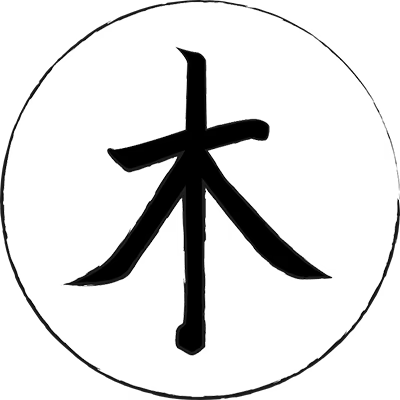
Liver – the wood element
The liver is associated with the wood element, which stands for growth, change and flexibility. Its emotions are anger, frustration and irritability.
In TCM, the liver ensures that Qi flows freely through the body. When anger or frustration builds up, energy becomes blocked too.
Ask yourself:
- Do I often feel frustration or anger?
- Do I sometimes feel trapped or blocked?
- What exactly makes me angry – and can I let it go?
Meditation for life energy
Meditation can be one of the deepest sources of fresh energy.
In Zen, Zazen is practised – simple sitting without concepts. You sit upright, observing what happens within you without intervening. You let go of control and ease into relaxed observation.
After a while – sometimes it takes patience – things become quieter. The body settles, thoughts run their course. And sometimes a state of complete relaxation and mindfulness arises that is truly free of thoughts.
That is the moment when Qi flows on its own.
The first step
You do not have to change everything at once. Choose one principle that speaks to you. Perhaps it is less media. Perhaps it is a walk in the forest. Perhaps it is simply this: sitting still and breathing for ten minutes.
Your vitality was never gone. It is only waiting for you to give it space.